Creating a good acronym is harder than it looks. You want something memorable, pronounceable, and ideally meaningful—but most importantly, you want people to actually use it instead of reverting to the full name.
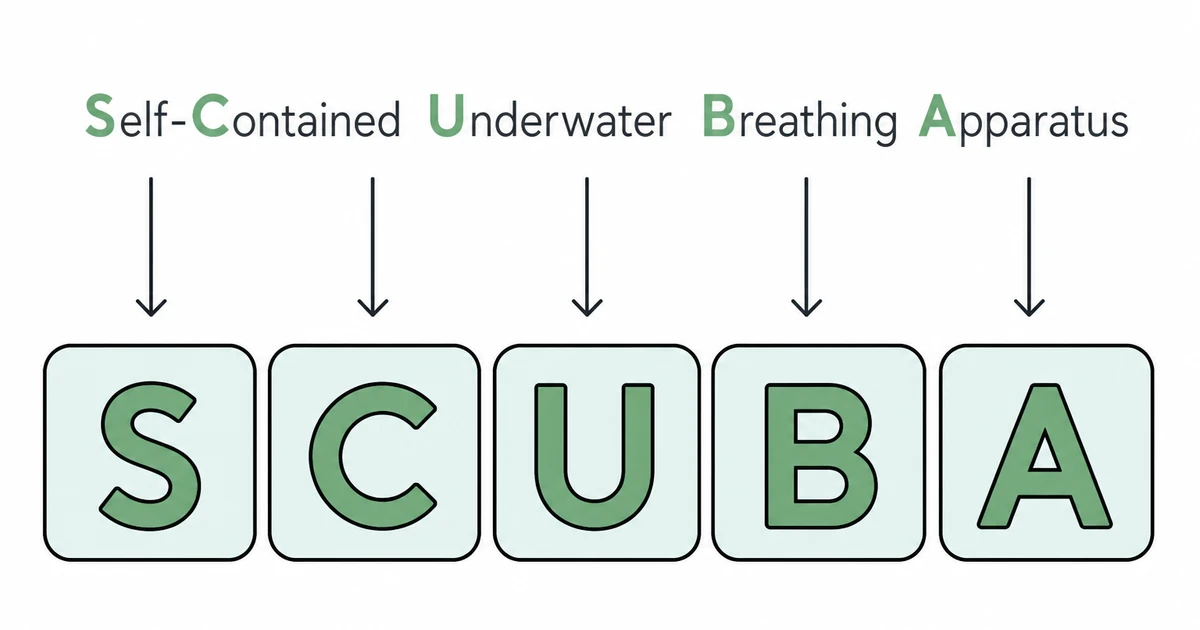
This guide walks through the 5-step process professional naming teams use, with real examples like SCUBA (Self-Contained Underwater Breathing Apparatus) and LASER (Light Amplification by Stimulated Emission of Radiation).
Step 1: Write the Full Name First
Before you think about letters, nail down the exact phrase you’re shortening. This seems obvious, but many teams jump straight to “what letters sound cool?” and end up with a forced acronym that doesn’t match what they actually do.
Bad approach:
“We need something with ‘X’ in it because X sounds tech-y.”
Good approach:
“Our tool helps distributed teams coordinate async work. The full name is ‘Asynchronous Team Coordination System.’”
Now you have raw material: Asynchronous Team Coordination System → ATCS.
If the full name feels clunky, fix that first. The acronym will inherit whatever awkwardness exists in the source phrase.
Step 2: Extract the Letters (But Be Flexible)
Take the first letter of each major word. Skip articles (a, an, the), prepositions (of, for, with), and conjunctions (and, or, but) unless you absolutely need them.
Examples:
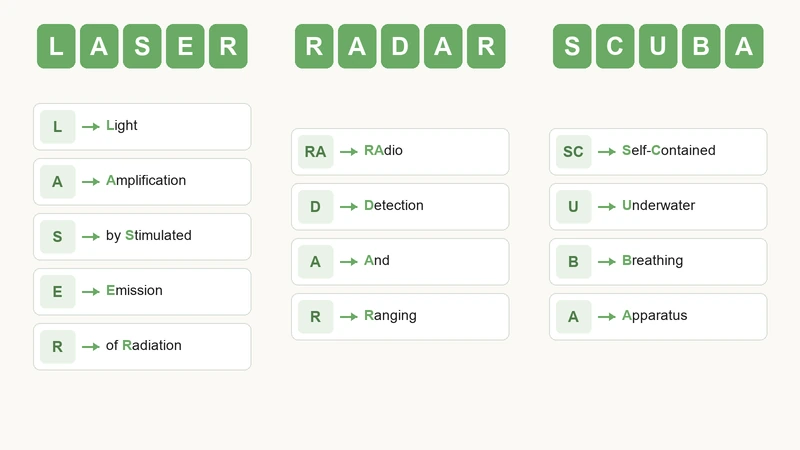
- LASER → Light Amplification by Stimulated Emission of Radiation (drops “by” and “of”)
- RADAR → RAdio Detection And Ranging (uses “RA” from “Radio” and keeps “and”)
- scuba → Self-Contained Underwater Breathing Apparatus (all content words)
If your initial extraction produces something unpronounceable (like “XNQZ”), you have three options:
- Rephrase the full name — “Asynchronous Team Coordination System” → “Team Async Coordination System” (TACS, better)
- Use more than just first letters — “Sound Navigation and Ranging” → SONAR
- Drop a word entirely — “Completely Automated Public Turing test to tell Computers and Humans Apart” → CAPTCHA (drops “test to tell” and “and”)
The goal is a balance: the acronym should suggest the full name, not necessarily encode it perfectly.
Skip the manual work. Paste your phrase and get acronym options in seconds.
Try the Acronym GeneratorStep 3: Test Pronounceability
Say it out loud. Then say it 10 times fast. Then ask someone else to say it.
Pronounceable acronyms win. That’s why we say “scuba” and “laser” as words, not letter-by-letter. They’re easier to remember, easier to say in meetings, and more likely to stick.
The pronounceability test:
- Can you say it without spelling it out? (SCUBA ✓, XQZV ✗)
- Does it sound like a real word or name? (LASER ✓, QWERT ✗)
- Would someone hearing it for the first time know how to spell it? (RADAR ✓, SYZYGY ✗)
If your acronym fails the test, go back to Step 2. Rephrase the full name or pick different letters.
Pro tip: Vowel-consonant alternation helps. SCUBA (S-C-U-B-A) alternates naturally. SQL (S-Q-L) doesn’t, which is why people argue about whether to say “sequel” or “S-Q-L.”
Step 4: Check for Collisions and Unwanted Meanings
Google your acronym. Then Google it with your industry. Then check Urban Dictionary.
You’d be surprised how many “perfect” acronyms already exist—or worse, mean something you don’t want to be associated with.
Real-world collision examples:
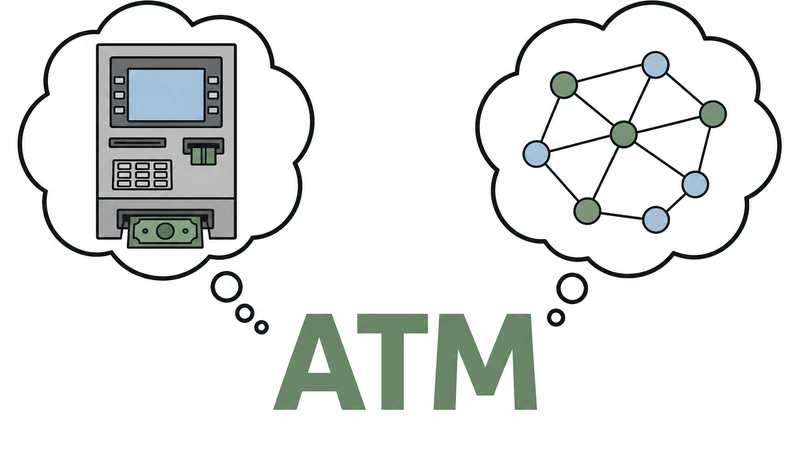
- ATM could mean “Automated Teller Machine” or “Asynchronous Transfer Mode” (networking)
- PDA could mean “Personal Digital Assistant” or “Public Display of Affection”
- ATM is taken (the bank machines got there first). So are RAM, PDF, and most three-letter combinations.
How to check:
- Google
"[your acronym]"— see what comes up - Google
"[your acronym]" + [your industry]— narrower context - Check acronym finder tools to see if it’s already in use
- Search social media (Twitter, LinkedIn) to see if anyone’s using it
If there’s a collision in your industry, pick a different acronym. If the collision is in a totally unrelated field (e.g., your fintech app shares an acronym with a medical device), it’s usually fine—but be aware of it.
Step 5: Test in Context
Before you commit, use the acronym in real sentences:
- “Let me send you the ATCS report.”
- “We’re migrating to the new ATCS platform next quarter.”
- “Have you tried ATCS yet?”
Does it feel natural? Does it save time, or does everyone just say the full name anyway?
The ultimate test: If people keep saying the full name instead of the acronym, your acronym failed. Go back to Step 2.
Bonus: The backronym check
Sometimes you have a great acronym but no good expansion. That’s when you create a backronym—a phrase constructed to fit an existing acronym.
Example: SOS doesn’t actually stand for “Save Our Souls” or “Save Our Ship.” It was chosen because the Morse code pattern (· · · — — — · · ·) is unmistakable. The backronyms came later.
If you’re in this situation, use a backronym generator to brainstorm expansions that fit your acronym.
Common Mistakes to Avoid
- Forcing it — If you need to use the 3rd letter of one word and the 2nd letter of another, your acronym is too forced
- Ignoring pronunciation — XQZV might look cool, but no one will say it
- Skipping the collision check — Always Google first
- Making it too long — Five letters is the practical maximum for a memorable acronym
- Forgetting the audience — Internal team acronym? You have more freedom. Public-facing product? Be more conservative
Tools to Help
If you’re stuck, try an acronym generator to brainstorm variations. It’ll take your full name and suggest multiple acronym options, including ones you might not have thought of.
For reverse lookups (you have an acronym and need the expansion), use the reverse acronym generator.
Real Examples to Learn From
| Acronym | Full Name | Why It Works |
|---|---|---|
| SCUBA | Self-Contained Underwater Breathing Apparatus | Pronounceable, memorable, sounds like a real word |
| LASER | Light Amplification by Stimulated Emission of Radiation | Same—it’s now so common people forget it’s an acronym |
| RADAR | Radio Detection and Ranging | Short, punchy, easy to say |
| ASAP | As Soon As Possible | Informal but universally understood |
| YOLO | You Only Live Once | Captured a cultural moment, easy to say |
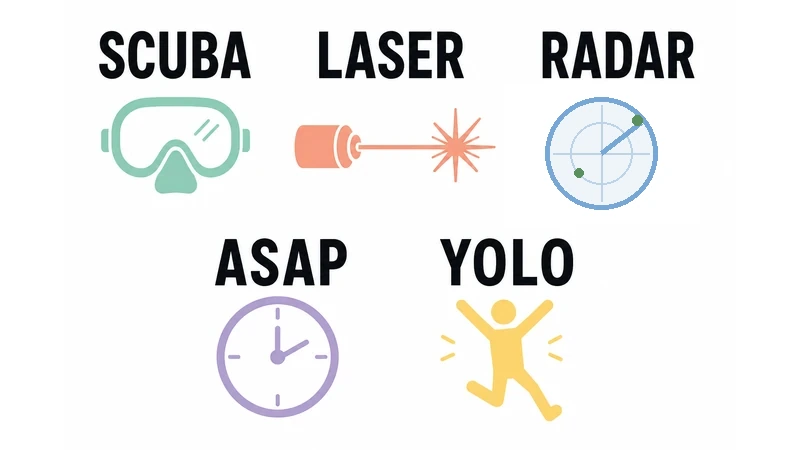
Notice the pattern: the best acronyms are pronounceable and short. Aim for 3-5 letters that form something you can say out loud without cringing.
- Write the full name first — fix a clunky phrase before extracting letters
- Skip articles, prepositions, and conjunctions when extracting letters
- Pronounceable beats clever: if people can't say it, they won't use it
- Always check for collisions before committing
- If people keep saying the full name, the acronym failed — iterate
Next steps: Try making your own acronym using the acronym generator, or test your knowledge with the acronym quiz.
Sources
Retrieved September 2, 2026: