A backronym is a phrase created to fit an existing word, so the word can be read as an acronym. The word comes first; the expansion is invented afterward. The name says it literally: back + acronym.
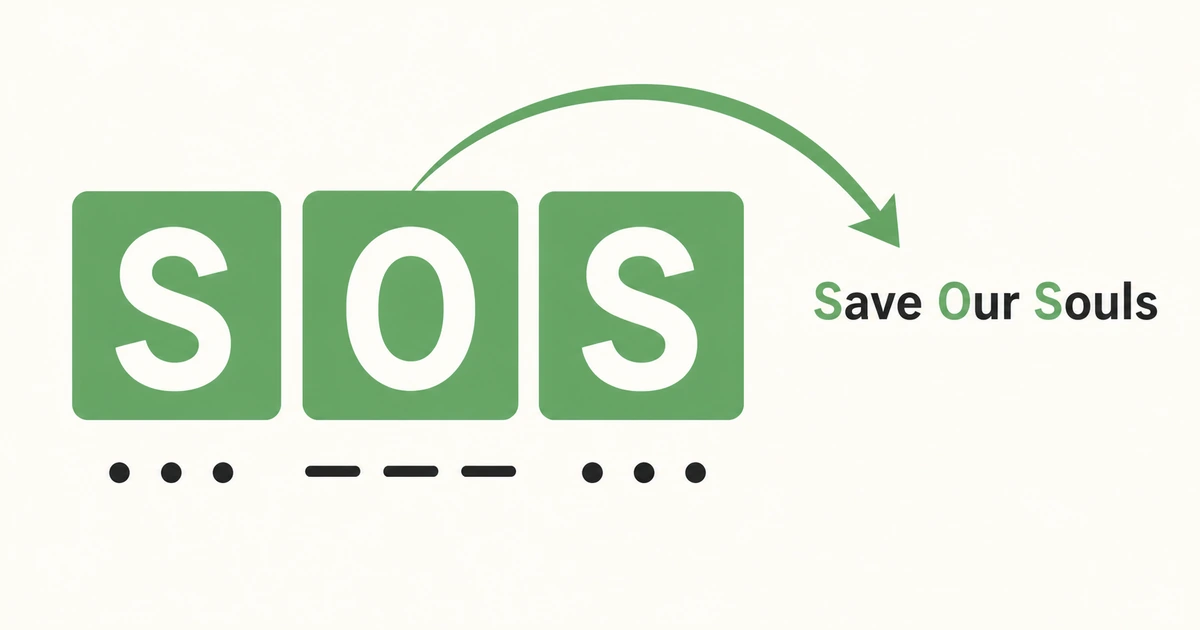
The classic example is SOS. It doesn’t actually stand for “Save Our Souls” or “Save Our Ship” — it was chosen as a distress signal because its Morse code pattern (· · · — — — · · ·) is impossible to mistake. The expansions were attached later. That’s a backronym.
Backronym vs. Acronym: What’s the Difference?
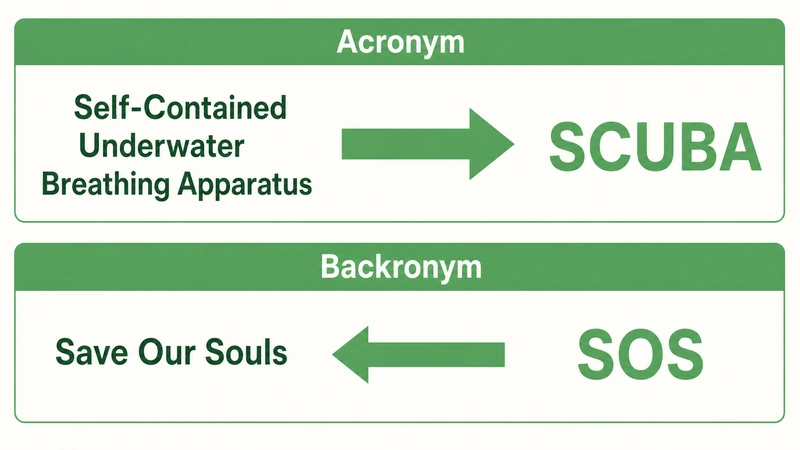
The two work in opposite directions:
| Acronym | Backronym | |
|---|---|---|
| What comes first | The full phrase | The word |
| Process | Phrase → first letters → word | Word → invent a phrase to fit |
| Example | Self-Contained Underwater Breathing Apparatus → SCUBA | SOS → “Save Our Souls” (invented later) |
If the phrase existed before the word, it’s an acronym. If someone looked at an existing word and reverse-engineered a phrase for it, it’s a backronym.
Where the Word “Backronym” Comes From
The word itself is young. The earliest known print appearance is from 1983, in The Washington Post’s reader neologism contest: Meredith G. Williams won with “backronym — same as an acronym, except that the words were chosen to fit the letters.”
The practice, of course, is far older than the name — people have been retrofitting meanings onto words for as long as words have existed.
Famous Backronym Examples
- SOS — chosen in 1906 as the international distress signal for its unmistakable Morse pattern; “Save Our Souls” and “Save Our Ship” were invented afterward
- Apgar — the newborn health score is named after Dr. Virginia Apgar, who created it in 1952; Appearance, Pulse, Grimace, Activity, Respiration was devised later as a learning mnemonic
- AMBER Alert — created in 1996 after the abduction of Amber Hagerman; officially backronymed as “America’s Missing: Broadcast Emergency Response”
- Yahoo — the founders picked the word first (from Gulliver’s Travels), then expanded it as “Yet Another Hierarchical Officious Oracle”
- Adidas — from founder Adi Dassler’s name; “All Day I Dream About Sports” is a fan-made retrofit
Backronyms That Aren’t: False Etymologies
Some famous “acronym origins” are myths — the words were never acronyms at all:
- GOLF does not stand for “Gentlemen Only, Ladies Forbidden.” The word comes from the Dutch kolf, meaning “club.”
- POSH does not stand for “Port Outward, Starboard Home.” No historical evidence supports it; the word predates the story.
These false backronyms spread because they’re satisfying stories. Always check before repeating one — dictionary etymologies take ten seconds to verify.
Why Make a Backronym?
Backronyms solve a real naming problem: you already have a great word, and now it needs to mean something.
- Memorability — a pronounceable word beats a letter string, so people pick the word first and justify it after
- Branding — a name that spells something relevant (a project called ATLAS, a team called WAVE) sticks better than arbitrary letters
- Humor — joke backronyms are a genre of their own, from community groups to Wi-Fi names
How to Create a Backronym
- Start with the word you want — ideally pronounceable, short, and relevant to your topic
- Assign each letter a word — work letter by letter; prioritize the first and last letters, which readers notice most
- Keep it plausible — the expansion should sound like something a real organization would say, not a forced word salad
- Test it out loud — if people smile at the word and the expansion, you have a winner
Have a word, need an expansion? Generate backronym options letter by letter.
Try the Backronym Generator- A backronym is a phrase invented to fit an existing word — word first, expansion later
- Acronyms and backronyms run in opposite directions: phrase-to-word vs. word-to-phrase
- SOS is the classic case: the Morse pattern came first, "Save Our Souls" came later
- Famous origins like GOLF and POSH are myths — verify before repeating
- To make one: pick the word first, then assign letters, keeping the expansion plausible
Want to go the other direction — a phrase into an acronym? Use the acronym generator. To look up what existing letters stand for, try the acronym finder, or test yourself with the acronym quiz.
Sources
Retrieved September 2, 2026: